
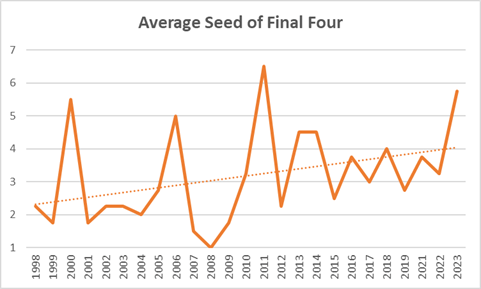
This year’s NCAA Men’s Basketball tournament is the first in which none of the four #1 seeds made it to the Elite Eight. It seems a remarkable year for upsets. But looking closer, it’s actually part of a long-term trend. If you look at the Final Four teams over the past 25 years, you can see that the average seed of a Final Four team has gone from about 2.3 to 4. In other words, fewer of the top-seeded teams are making it through to the end of the tournament.
Why is that? There are three possible explanations for the trend.
Competence
One explanation is that the NCAA selection committee is getting worse at its job. The committee consists of 12 members who are either college athletic directors or league commissioners. The committee goes through a multi-step process to select and seed the teams. 32 teams get into the tournament via auto bids based on winning the conference titles (unless the winner happens to be ineligible). The remaining 36 are chosen by the committee. All 68 teams are then seeded by the committee. As in any seeded tournament, the top-ranked teams get an easier path to the finals. So there is a self-confirming bias that makes it easier for better seeded teams to go further in the tournament. Even with that bias, there was only one year in this 25-year span when all the #1 seeds advanced to the final. With all the inherent uncertainty that makes the sport so compelling to begin with, it’s not surprising that it rarely goes exactly to plan. But it’s gone progressively less and less to plan over this time span. From that information alone, it’s not hard to conclude that the committee is getting progressively worse at what they do. Perhaps the committee members are too consumed with their full-time jobs to put the right time and focus on their duties. Perhaps they’ve failed to keep up with the changes in the game, bringing assumptions about teams, conferences, and performance metrics that no longer ring true. Much has been said in recent years regarding how the game of basketball has changed. Maybe that change requires a different perspective to see a team’s true value than those on the committee can offer.
Complexity
Another explanation is that it’s just getting harder to predict how teams will do. Between the one-and-done rule and the transfer portal, entire teams and their dynamics are changing between seasons. Decades ago, returning 4-year players gave more consistency to programs, and made it easier to gauge teams on the rise or fall. With teams consisting of more new recruits and transfers, there is more variability between seasons and even within them. Teams from typically less successful conferences who do manage to maintain consistency now have an advantage by the time certain classes are seniors thanks to their familiarity and comfort when playing together. Either because of this or independent of it, there also seems to be more parity in the game overall. Top teams from the so-called “mid-majors” are indistinguishable from those of the top conferences. Viewed from this perspective, the seeding process hasn’t gotten worse, it’s just gotten a lot harder to do.
Conspiracy

The cynical take is that this trend is neither the result of a bad job nor a harder job, but an intentional production. Think about what makes headlines in the media coverage and social media feeds during the tournament. Is it about the favorites winning as expected? Of course not. No one is surprised when a 4-seed beats a 13-seed. It’s the amazing upsets and Cinderella stories. March Madness has become such a cultural phenomenon because of the chaos it seemingly inspires, not because people love college basketball. The Fairleigh Dickinson coach was the one featured on the Today Show the next morning, not the winning coach of #2 UCLA. The NCAA made $1.14 billion in 2022 from the tournament, mostly from TV revenue. That is more than four times what they made in 1998. With so much of that money coming from TV revenue, is it really that crazy to think the committee does its best to script a cinderella underdog a la Hoosiers into reality? In the most extreme form of this explanation, the NCAA is deliberately manipulating the seedings to increase the number of upsets in order to boost viewership and revenues. In a less extreme form, the NCAA doesn’t care about accurate seedings and therefore has no vested interest in finding ways to improve it. If the product is simply good enough and keeps making the NCAA more and more money, then why mess with it?
Which of the three seems the most plausible to you?

 The Gameplan Review